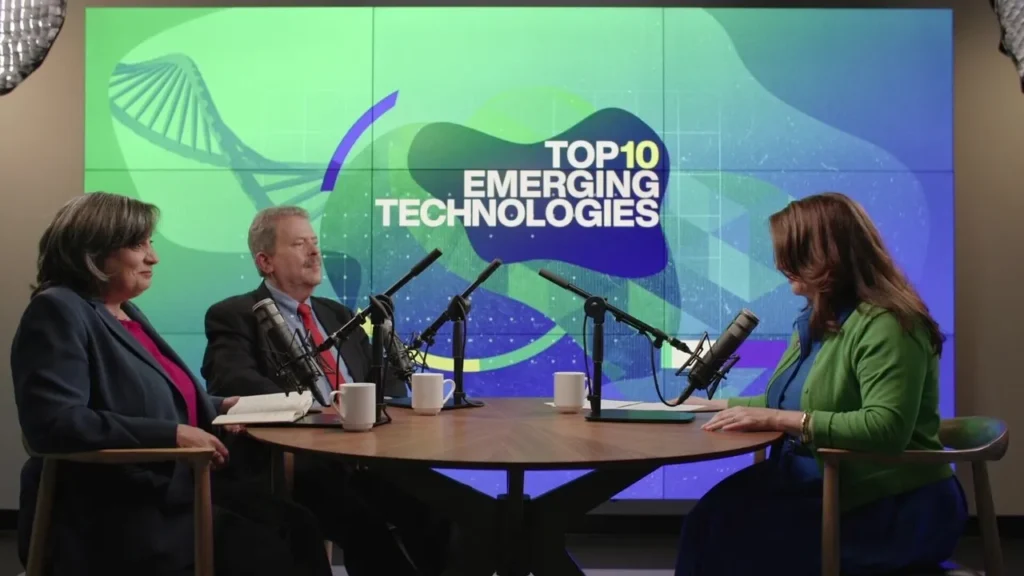
Every year, there’s a familiar moment when the World Economic Forum releases a list of emerging technologies and the internet collectively asks the same question.
Is this real progress, or just a curated wish list?
This year’s announcement, developed with the scientific journal Frontiers, lands a little differently. Not louder. Not more ambitious. Just more grounded.
The latest list of key emerging technologies unveiled by the World Economic Forum in collaboration with Frontiers reads less like a sci-fi preview and more like a snapshot of what researchers actually think could matter soon.
And that shift is worth paying attention to.
What this list is, and what it isn’t
First, some context.
This is not a ranking. It’s not a prediction that all these technologies will succeed. And it’s definitely not a shopping list for governments to blindly adopt.
The WEF and Frontiers frame the list as early signals. Technologies that are moving out of pure research and into applied testing. Ideas with enough momentum to potentially shape economies, healthcare, energy systems, and digital infrastructure.
Some will stall. A few will scale. Most will evolve in unexpected ways.
That uncertainty is baked into the process.
The focus has shifted toward resilience and repair
One thing stands out quickly.
This year’s technologies are less about disruption and more about repair. Fixing systems that are already under strain rather than inventing entirely new ones.
Climate-related technologies feature heavily. Advanced battery recycling. New materials for energy storage. Methods for capturing and reusing carbon rather than simply offsetting it.
There’s a noticeable emphasis on making existing clean technologies more efficient, cheaper, and easier to deploy. That suggests a quiet admission that breakthroughs alone aren’t enough anymore.
We need follow-through.
AI is present, but not in the way you might expect
Artificial intelligence is still on the list, but the tone around it has changed.
Instead of general-purpose AI or bigger models, the focus is on specialized systems. AI for scientific discovery. AI for materials research. AI tools designed to work alongside humans rather than replace them.
That’s where things get interesting.
The framing suggests a shift away from AI as a consumer spectacle and toward AI as infrastructure. Invisible. Embedded. Useful in narrow, high-impact ways.
It’s a subtle change, but an important one.
Biology and health tech are quietly advancing
Several highlighted technologies sit at the intersection of biology and engineering.
Think precision fermentation. New ways to engineer microbes for food, medicine, and materials. Advanced biomanufacturing techniques that promise more control and less waste.
There’s also growing attention on health monitoring technologies. Not flashy wearables, but systems that combine sensors, data analysis, and early warning signals to detect disease risk sooner.
Early signs suggest these tools could shift healthcare from reactive to preventive. But that depends heavily on regulation, trust, and data governance.
Those parts are still unresolved.
Materials science is having a moment again
Materials rarely get headlines, but they show up everywhere on this list.
New composites. Programmable materials. Substances designed to change properties based on temperature, pressure, or electrical input.
These innovations don’t usually make bold promises. They just quietly make other technologies possible.
Better materials can mean lighter vehicles, more efficient buildings, and longer-lasting infrastructure. The kind of progress that compounds over time.
This part matters more than it sounds.
Why the WEF and Frontiers partnership matters
It’s easy to dismiss WEF reports as abstract or overly polished. And to be fair, some deserve that criticism.
What makes this collaboration with Frontiers notable is the tighter connection to peer-reviewed research. The technologies highlighted are backed by published studies, not just trend analysis or industry enthusiasm.
That doesn’t guarantee success. But it does raise the floor.
It also reflects a broader effort to bridge the gap between research labs and policymakers. A space where misunderstandings are common and timelines rarely align.
What’s missing is just as revealing
There are notable absences.
No grand promises about quantum computing solving everything. No sweeping claims about fully autonomous cities. No declarations that a single technology will reshape society overnight.
That restraint feels intentional.
Instead, the list leans toward incremental advances that, when combined, could reshape systems quietly. Energy grids that waste less. Supply chains that adapt faster. Healthcare that intervenes earlier.
Not revolutionary on their own. Potentially transformative together.
What people should realistically expect next
For most readers, nothing will change tomorrow.
These technologies won’t show up in products next month or policies next week. They’re still early. Many are expensive. Some require entirely new standards and skills.
What this list does is signal where attention is moving. Where funding may flow. Where governments might start experimenting with pilot programs.
It’s a map, not a forecast.
And like most maps, it’s useful as long as you remember it isn’t the territory itself.
A quieter kind of optimism
There’s a tone running through this year’s release that’s hard to miss.
It’s optimistic, but cautiously so. Less about bold promises. More about steady progress.
That might not generate viral headlines. But it reflects a maturing conversation around technology’s role in society.
Big problems won’t be solved by one breakthrough. They’ll be addressed through many small, coordinated improvements.
If that’s the future these emerging technologies point toward, it’s a future that looks less dramatic.
And maybe more realistic.