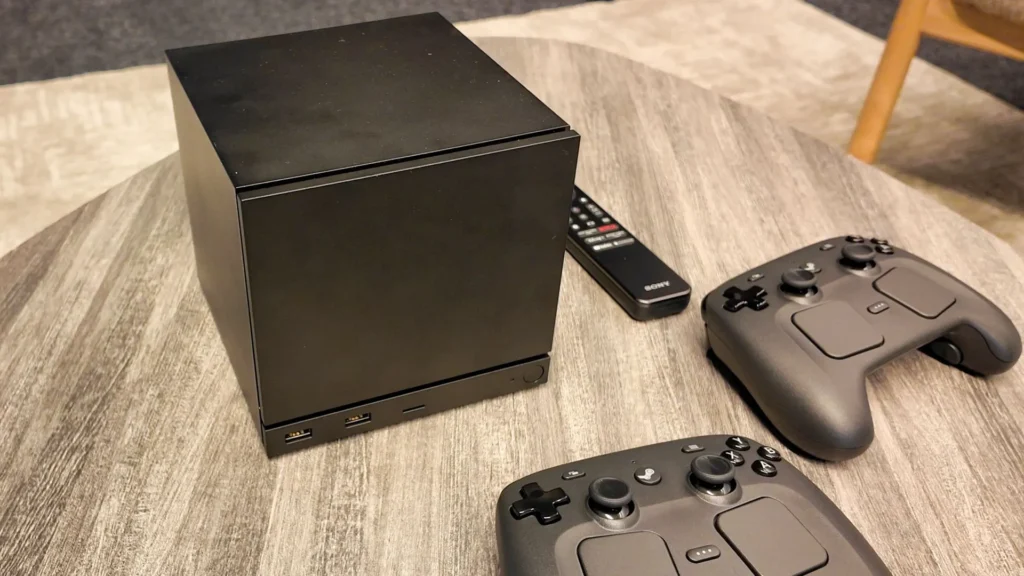
After years of speculation and a previous stumble, Valve Corporation has officially pulled back the curtain on its next-gen hardware: the revived “Steam Machine” console, slated for a spring 2026 launch. This time, the company promises a single, highly-refined box designed for living-room play but powered like a PC. (via Windows Central)
A New Box, Not Another Mini PC
Valve’s original Steam Machines experiment from 2015 partnered with multiple OEMs ended in disarray due to inconsistent hardware and Linux-gaming support. This version takes a different tack: it’s built in-house, tightly spec’d and explicitly optimised for the TV-connected living room. Industry outlets note the design resembles a “chopped” console, reminiscent of the Xbox Series X, but leaner and with Valve’s signature SteamOS 3 at its core. (via Game8)
Steam Machine 2026: Full Specs Breakdown
Processor (CPU)
– Custom AMD Zen 4
– 6 cores / 12 threads
– Target clock: 4.2–4.6 GHz boost
– Similar to a console-optimized Ryzen 7600
Graphics (GPU)
– AMD RDNA 3 architecture
– 28 Compute Units
– Estimated 8–9 TFLOPS
– Expected 4K gaming performance
Memory
– 16 GB DDR5 system RAM
– 8 GB GDDR6 VRAM
– High-bandwidth shared pool for faster texture streaming
Storage
– 512 GB or 2 TB NVMe SSD options
– PCIe Gen 4 speeds
– Expandable via microSD
Ports & Connectivity
– HDMI 2.0
– DisplayPort 1.4 (4K240 / 8K60)
– Multiple USB-C & USB-A ports
– Gigabit Ethernet
– Wi-Fi 6E / Bluetooth 5.3
– Front SD card reader
Performance Expectations
– 4K 60 FPS in most modern AAA titles
– 1440p 120 FPS in esports games
– SteamOS 3 + Proton for Windows game support
– Significantly quieter and cooler than traditional desktops
What This Means for Gamers & the Industry
For players, the promise is simple: your full Steam library at home with console ease. No need to stream or endure PC complexities. And for the broader market, Valve is blurring console and PC lines an industry trend where Microsoft, Sony and Nintendo are already feeling pressure.
One notable change: Valve says the Steam Machine will support not just Steam games but also (via compatibility layers) Windows-based titles. The move could accelerate mainstream appeal of PC gaming in the living room if execution matches expectation.
Pricing and Market Strategy
Valve hasn’t confirmed a retail price yet. But analysts estimate the base model may land somewhere between US $650 and US $750, making it competitive versus the Xbox Series X (~$550) and the soon-expected PS5 Pro (~$750+). (via Windows Central)
If this pricing holds, Valve’s gamble is to woo both console-owners looking for TV gaming and PC gamers wanting a more relaxed setup. The real question: will it deliver performance and polish under that budget?
Challenges from Past & Present
Despite its hopeful return, the Steam Machine’s past still looms. The 2015 model struggled with Linux game compatibility and confusing hardware choices. This time Valve must ensure widespread developers support, driver stability and seamless plug-and-play experience.
Supply-chain headwinds also matter memory and storage component shortages are driving cost inflation in hardware globally. Valve will need to mitigate that if it wants the pricing to stay appealing. (via Windows Central)
What to Expect Before Launch
Between now and Spring 2026, expect further details on models (possibly “Pro” or “Elite”), bundles with the new Steam Controller, and importantly, software support. Valve will extend its Deck-Verified program to include the Steam Machine and upcoming Steam Frame VR headset helping games indicate compatibility out of the box. (via Pure Xbox)
We’ll also want to watch if Valve opens up for other manufacturers (“Powered by SteamOS”) or keeps the hardware closed. That decision could impact mod-ability and ecosystem strength.
Our Take
It’s bold of Valve but exactly what many gamers have asked for: one box that bridges PC power, streaming convenience and living-room comfort. If the specs deliver and the pricing holds, the Steam Machine could change how we view consoles not as closed ecosystems, but as flexible gaming hubs. But if bundled features, performance or game compatibility fall short, scepticism will return faster than Steam-cache loading times. The hope? This time Valve isn’t just iterating they’re redefining.