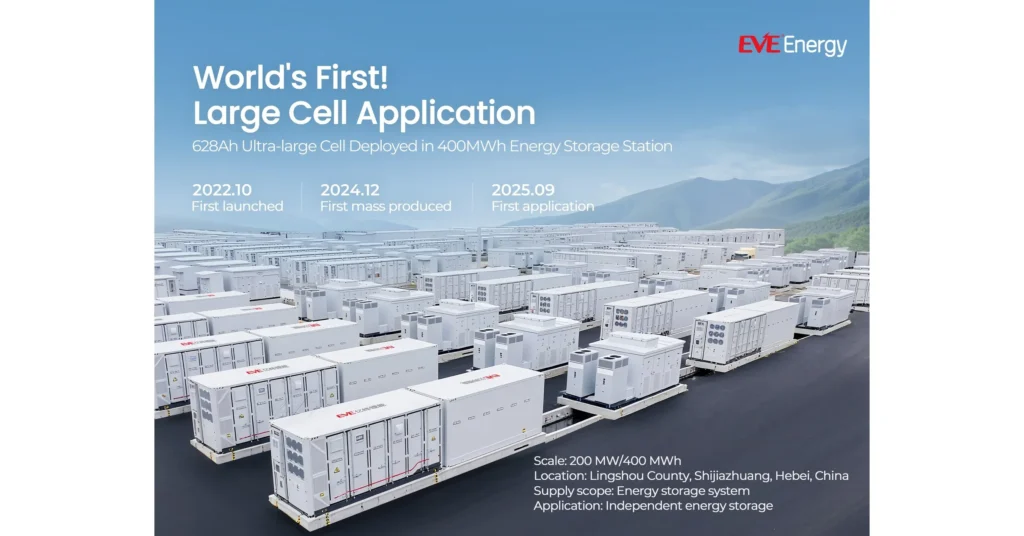
In a major leap for grid-scale energy storage, EVE Energy has connected a 400 MWh battery facility to the grid in Hebei, China, using ultra-large 628Ah cells. It’s being hailed as a global milestone in battery tech, with implications for how power grids manage renewable energy, reliability, and peak demand. (SolarQuarter)
The Project at a Glance
The facility is part of the Ruite New Energy Project in Lingshou, Hebei, and is rated 200 MW / 400 MWh. What makes this stand out is the battery cell architecture: ultra-large 628Ah cells, which are more efficient than typical smaller-cell configurations. EVE Energy also delivered more than 80 large-scale “Mr. Giant” battery systems and 40 converter cabins in one week to support this rollout.
Why Cell Capacity and Scale Matter
Larger Ah (ampere-hour) cells help reduce manufacturing complexity, lower interconnections between cells, and improve energy density. That means fewer parts, less wiring, and potentially lower costs per MWh of storage. When done well, big battery projects can also reduce losses, improve safety, and simplify maintenance. This project is proof that ultra-large cell tech is moving beyond lab or pilot phases into real utility-scale deployment.
How This Supports Renewable Integration
Energy storage is often the missing link in renewables adoption: solar and wind generate power intermittently, but demand doesn’t always align. A 400 MWh battery can store surplus renewables generated during peak production times (e.g. midday solar) and dispatch them during high demand (evening, cloudy hours). This enhances grid stability, reduces curtailment of green energy, and allows regions to rely less on fossil backup plants.
Global Impacts & Exports of Technology
Interestingly, EVE Energy isn’t keeping this advance to itself. The company has already shipped similar “Mr. Giant” battery systems to markets in Europe and Australia. That suggests this isn’t just a localized test it could influence storage standards globally. As nations push for tighter climate targets and more renewables, scalable storage tech like this becomes central to achieving 24/7 clean electricity.
Challenges & Risks to Watch
While the scale is impressive, several obstacles remain:
- Cost and investment risk: Building, operating, and maintaining large battery systems still involves high upfront cost. The return on investment depends heavily on electricity pricing, incentives, and regulation.
- Durability & performance consistency: Ultra-large cells may behave differently over time heat management, degradation, and safety under stress are critical factors.
- Supply chain constraints: Big cells require reliable supply of raw materials (lithium, cobalt, etc.), plus manufacturing capacity. Disruptions in any link can escalate cost or delay deployment.
- Regulatory & grid integration complexity: Grid codes, interconnection standards, permitting, and local infrastructure must adapt to accommodate large battery storage, especially when dispatching power or providing ancillary services like frequency regulation.
What to Track Going Forward
Here are some indicators to watch to see whether large-battery projects like this will truly scale:
- Performance metrics over time actual vs expected ramp-up, discharge cycles, degradation.
- Whether similar big-cell storage projects are announced in Europe or North America with matching size & technology.
- Policy and regulatory changes that support storage incentives capacity payments, subsidies, tax credits, or streamlined permitting.
- Integration with renewables projects whether battery storage is built alongside solar, wind, etc., not just as standalone facilities.
- Costs of grid stabilization services how much these large systems reduce blackout risk, curtailment, or need for peaker plants.
My Take
This 400 MWh installation from EVE Energy is more than just a number it feels like a shift. Storage at this scale using ultra-large cells could be the turning point where green energy isn’t just idealistic, but practical and reliable. If regions in the U.S., EU, Australia adopt similar tech, grids will become more resilient, renewables more useful, and energy transitions less theoretical. That said, keeping things safe, reliable, and cost-efficient will make or break the promise. For policymakers, this is the kind of tech advance that demands supportive regulation; for energy stakeholders, the kind worth paying attention to.