Biotech has never been short on bold promises.
AI would cut drug discovery timelines in half. Algorithms would replace years of lab work. Biology would finally become predictable.
Most of that hasn’t happened. At least not in the way it was pitched.
What is happening feels more subtle and, frankly, more realistic. Biotech R&D is increasingly being shaped by hybrid AI ecosystems, setups where machine learning, traditional computation, lab automation, and human expertise work together rather than trying to replace one another.
It’s less flashy. It’s also starting to work.
What “hybrid AI” means in a biotech lab
Hybrid AI doesn’t refer to one model or one platform.
It’s an ecosystem. A combination of tools that handle different parts of the research pipeline.
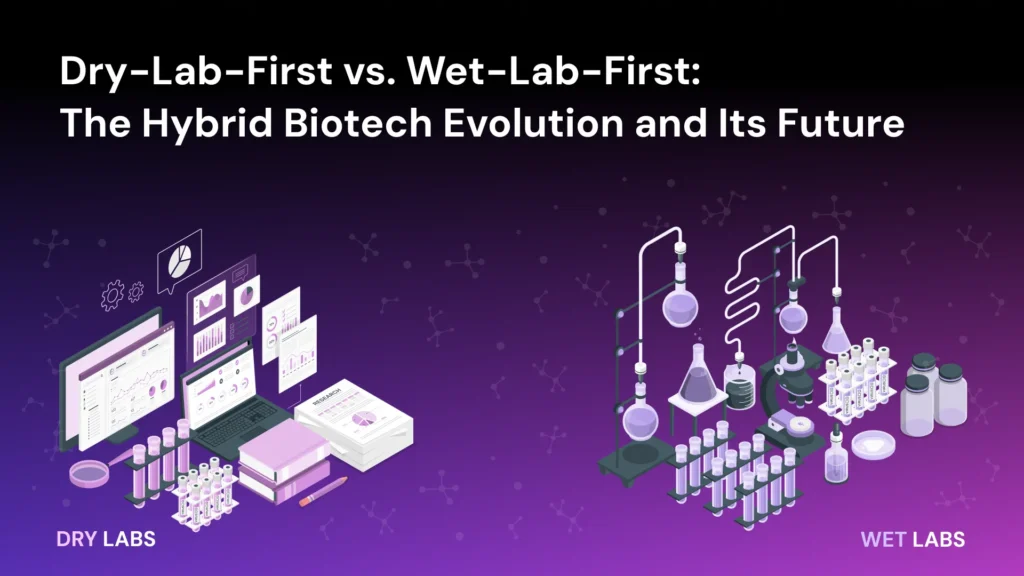
You might see machine learning models predicting promising molecular structures, physics-based simulations checking feasibility, automated lab systems running experiments, and scientists interpreting results and adjusting strategy.
No single system runs the show.
That’s where things get interesting.
Early AI-first biotech companies tried to automate everything. Many learned the hard way that biology doesn’t cooperate with clean, end-to-end automation. Hybrid approaches accept that complexity instead of fighting it.
Why pure AI approaches hit a wall
Biology is noisy. Incomplete. Context-dependent.
Pure AI systems trained on historical data struggle when they encounter edge cases, and biotech is full of edge cases. Rare interactions. Unexpected toxicity. Manufacturing quirks that don’t show up in datasets.
Researchers found that AI works best when it augments existing methods rather than replacing them.
So instead of asking, “Can AI discover a drug on its own?” the question became, “Where does AI actually add leverage?”
The answers tend to cluster around prioritization, optimization, and decision support.
This part matters more than it sounds.
The mid-stage shift is especially important
Early discovery gets most of the attention, but mid-stage R&D is where hybrid AI is having the biggest impact.
This is the phase where molecules are refined, safety risks are explored, and development paths are chosen. Historically, it’s slow and expensive.
Hybrid systems allow teams to model multiple scenarios before committing resources. AI predicts outcomes. Simulations test edge conditions. Labs validate the most promising options.
The result isn’t certainty. It’s better odds.
And in biotech, better odds are everything.
Lab automation becomes a first-class citizen
Another key change is the rise of automated labs as part of the AI ecosystem.
Robotic systems generate high-quality, standardized data at scale. That data feeds back into models, improving predictions over time. Humans step in to interpret results and design the next set of experiments.
It’s a loop, not a pipeline.
This feedback-driven approach is reshaping how teams think about experimentation. Fewer one-off tests. More continuous learning.
Early signs suggest this leads to more reproducible results and faster iteration cycles.
Data integration is the real challenge
If there’s a bottleneck in hybrid AI biotech, it’s data integration.
Biological data comes from everywhere. Genomics. Proteomics. Imaging. Clinical records. Manufacturing logs. Much of it lives in incompatible formats.
Hybrid ecosystems have to stitch this together in ways that models can actually use. That’s harder than training a neural network.
Companies investing heavily in data infrastructure, not just algorithms, appear to be pulling ahead. Quietly, but consistently.
This is not glamorous work. It’s foundational.
Humans are still central, just in different roles
One misconception about AI in biotech is that it sidelines scientists.
In practice, the opposite seems to be happening.
Researchers are spending less time on repetitive tasks and more time on hypothesis design, interpretation, and strategy. They’re asking better questions because the system can explore answers faster.
That shift requires new skills. Comfort with data. Willingness to trust models without deferring to them blindly.
The best teams treat AI as a colleague, not a boss.
Investors are adjusting their expectations
This hybrid reality is also changing how investors evaluate biotech companies.
Grand claims about fully autonomous discovery platforms are met with skepticism now. What gets attention is evidence that AI improves specific decisions. Reduces failed experiments. Speeds up development milestones.
Investors want to see AI embedded in workflows, not bolted on for demos.
That’s a healthier standard.
Where this could lead next
Hybrid AI ecosystems are still evolving.
Over the next few years, expect tighter integration between software and lab hardware. More standardized data pipelines. Greater use of AI in manufacturing and scale-up, not just discovery.
You’ll also see fewer claims about replacing biology with computation, and more focus on collaboration between systems.
That’s a good sign.
Biotech progress has always been incremental, even when the outcomes are transformative. Hybrid AI fits that pattern. It doesn’t promise miracles. It promises fewer wrong turns.
In an industry where each wrong turn can cost years, that’s a meaningful shift.