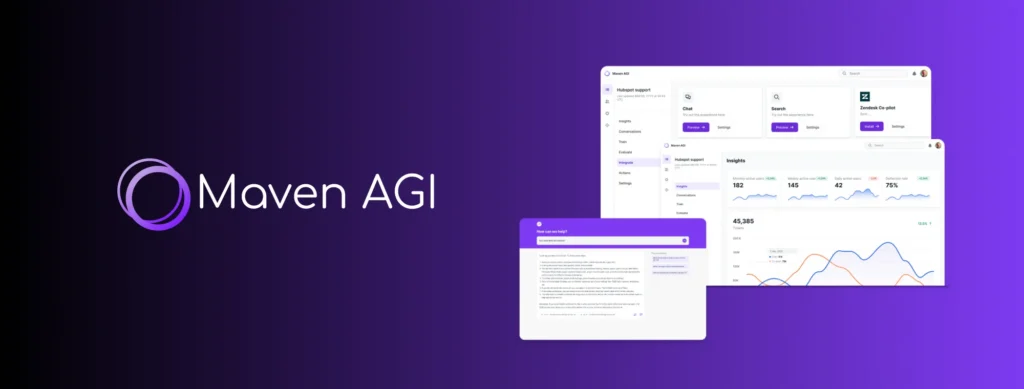
Revolutionizing Customer Service: The Rise of AI Customer Support Agents
In the fast-paced world of business, customer satisfaction has become a non-negotiable priority. To enhance the customer experience, companies are increasingly turning to innovative technologies that simplify interaction, shorten resolution times, and improve service quality. One of the most transformative developments in this quest is the advent of AI customer support agents. Companies such as MavenAGI are at the forefront of this technology, leveraging the power of advanced algorithms to elevate customer service as we know it.
MavenAGI, a newly established player in the software realm, has introduced an AI customer service agent built on the flexible capabilities of GPT-4. This sophisticated technology is designed to manage customer inquiries efficiently, outperforming traditional support models and allowing businesses to devote more resources to innovation and growth. Companies like Tripadvisor, Clickup, and Rho have already adopted this system, reaping benefits that range from time savings to enhanced customer satisfaction.
The Shift to AI-Driven Support
The decision to implement AI customer support agents marks a significant shift in how businesses approach customer service. Traditional support systems, which often relied on human agents, could become inefficient under the growing burden of customer inquiries. AI solutions not only alleviate this pressure but also bring about a host of other advantages. With the ability to handle large volumes of queries simultaneously, AI agents significantly reduce waiting times, providing immediate responses that can enhance customer satisfaction.
The technology behind MavenAGI’s offering is powered by GPT-4, the latest iteration of OpenAI’s language model. This model is capable of understanding context and generating responses that are both coherent and relevant. By leveraging this technology, AI customer support agents can engage in personalized conversations, understand user intent, and provide tailored solutions that mimic human agents without the operational costs associated with hiring large teams.
Why AI Customer Support Agents Matter
For businesses, the ramifications of adopting AI customer support agents are vast. One of the most immediate benefits is cost savings. By automating responses to common queries and issues, businesses can streamline their support operations, reducing labor costs and reallocating funds to more strategic initiatives. This leads to a more sustainable business model in an era where budgetary constraints are common.
Moreover, AI agents enhance the scalability of customer support systems. As businesses grow, the influx of customer queries often becomes overwhelming for existing support teams. With AI in place, companies can easily increase their support capacity without a proportionate increase in resource investment. This scalability is essential for startups and established firms alike, particularly as they expand their customer bases.
Furthermore, AI customer support agents can work around the clock. With a 24/7 presence, these virtual agents can cater to global customers, improving service availability and satisfaction. This continuous support ensures that clients can receive assistance whenever they need it, regardless of time zones.
Real-World Applications
The implementation of MavenAGI’s AI customer support agents represents a broader trend that encompasses various industries. For instance, tourism companies like Tripadvisor leverage AI to respond to travelers’ inquiries about bookings, recommendations, and even itinerary suggestions. By automating these interactions, they can enhance user engagement without overwhelming their human support teams.
Similarly, the project management tool Clickup uses AI support agents to assist users with onboarding and troubleshooting, helping them navigate the platform more effectively. By reducing friction in user experiences, Clickup boosts customer retention and loyalty.
Healthcare is another sector seeing promising applications of AI in customer support. Organizations are exploring the potential for AI to manage patient inquiries, schedule appointments, and provide information about services. This can alleviate pressure on administrative staff, allowing them to focus on more complex tasks that require a human touch.
The Future of Customer Support
As technology advances, the capabilities of AI customer support agents will only grow more sophisticated. Future iterations may incorporate predictive analytics, allowing these agents to foresee potential customer concerns based on historical data and user behavior. Such proactive engagement could eliminate many issues before they arise, creating an even smoother customer experience.
However, the transition to AI-driven support does raise questions about the future of human customer service agents. The role of the human agent will likely evolve rather than disappear. Skilled agents will focus on resolving complex issues, while AI handles routine inquiries. This collaboration could lead to a more balanced appointment of human and machine resources.
It is essential that businesses proceed with caution when integrating AI into customer service. Customers may feel frustrated if they encounter automated responses instead of personalized interactions, especially in situations involving sensitive issues. Striking the right balance between AI efficiency and human empathy will be critical.
Conclusion
The emergence of AI customer support agents like those developed by MavenAGI represents a revolutionary change in how businesses interact with their customers. By adopting these advanced solutions, organizations can improve efficiency, reduce costs, and enhance customer satisfaction. As the technology continues to evolve, we can expect to see even more innovative applications that further refine customer service practices. For entrepreneurs and business leaders, embracing this trend could be paramount in gaining a competitive edge in the evolving landscape of customer service.